


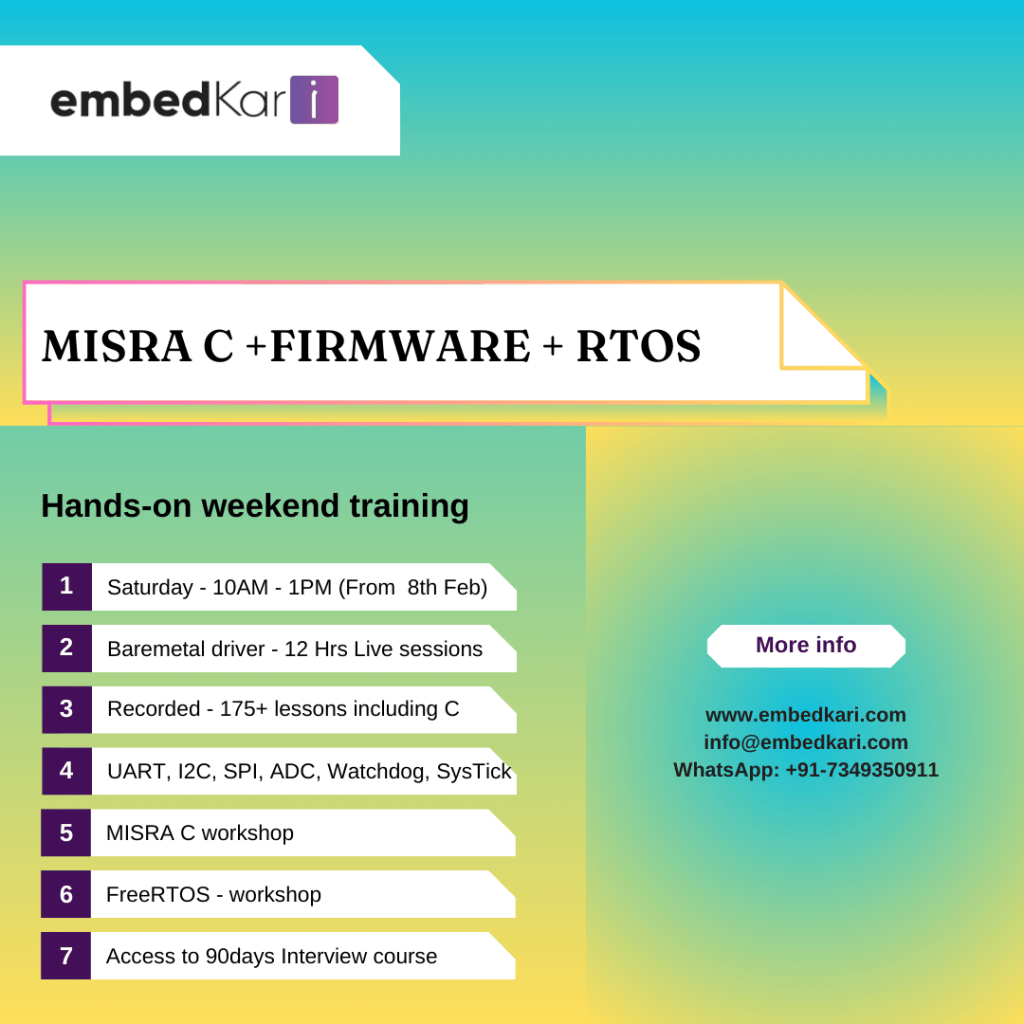
The Role of MISRA C, ARM Bare-Metal Drivers, RTOS, and Peripheral Communication :
Embedded systems drive the modern world, from automotive ECUs to industrial automation and consumer electronics. But mastering embedded software requires a strong foundation in structured programming, hardware interfacing, and real-time responsiveness. This article highlights four key aspects that every embedded engineer should focus on: MISRA C, ARM bare-metal drivers, RTOS, and peripheral communication with UART, I2C, SPI, ADC, Watchdog, and SysTick.
1. MISRA C: Ensuring Safe and Reliable Embedded Code
The MISRA C standard is the backbone of reliable embedded software development, particularly in safety-critical industries like automotive, aerospace, and medical devices. It provides a set of coding guidelines to eliminate undefined behaviors, avoid runtime errors, and improve code maintainability. Adhering to MISRA C ensures that embedded software meets high safety and reliability standards.
Why is MISRA C important?
- Prevents unsafe coding practices in C
- Enhances portability and maintainability
- Reduces risks of undefined behaviors in embedded systems
- Helps meet industry safety certifications like ISO 26262
2. ARM Bare-Metal Drivers: Understanding Hardware at the Core Level
Before diving into RTOS, engineers must master bare-metal programming on ARM Cortex-M microcontrollers. Writing bare-metal drivers helps in understanding register-level programming and microcontroller architecture.
Key bare-metal driver development topics:
- GPIO control: Setting up input/output pins
- Interrupt handling: Managing external and internal events
- Clock configuration: Optimizing performance vs. power consumption
- Memory-mapped registers: Direct control of peripherals
Mastering ARM bare-metal programming builds a solid foundation for working with real-time operating systems and complex embedded applications.
3. Real-Time Operating System (RTOS): Managing Multitasking Efficiently
As embedded systems become more complex, using an RTOS becomes necessary. An RTOS enables efficient multitasking, scheduling, and real-time constraints management.
Why should you learn RTOS?
- Task scheduling for real-time performance
- Inter-task communication using queues, semaphores, and mutexes
- Power-efficient designs with sleep modes and tickless idle
- Deterministic behavior for safety-critical applications
Popular RTOS choices include FreeRTOS, Zephyr, and RTEMS. Learning RTOS helps in designing systems that handle multiple tasks efficiently while meeting real-time constraints.
4. Peripheral Communication: Mastering UART, I2C, SPI, ADC, Watchdog, and SysTick
Interfacing microcontrollers with external peripherals is a fundamental skill for embedded engineers. Here’s why these peripherals matter:
- UART (Universal Asynchronous Receiver-Transmitter): Essential for serial communication, debugging, and bootloader implementation.
- I2C (Inter-Integrated Circuit): A low-speed protocol for communicating with sensors, EEPROMs, and RTC modules.
- SPI (Serial Peripheral Interface): A high-speed communication protocol for flash memory, displays, and high-speed sensors.
- ADC (Analog-to-Digital Converter): Converts real-world analog signals (like temperature and voltage) into digital values for processing.
- Watchdog Timer: Ensures system reliability by resetting the microcontroller in case of software faults.
- SysTick Timer: A crucial timer in ARM Cortex-M microcontrollers used for task scheduling and periodic interrupts.